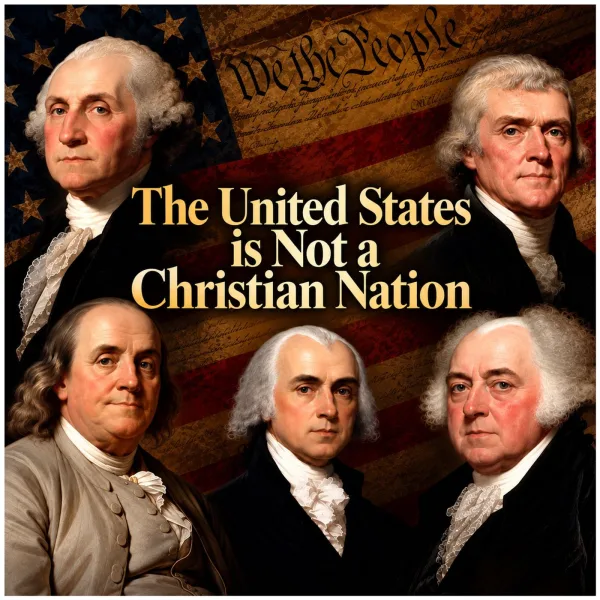
The United States is Not a Christian Nation
Timestamps may run a little early on this show. Its publisher adds adverts to the audio as you download it, and everyone gets a different set, so the recording in your player is slightly longer than the one these timings came from. Expect to land shortly before the moment you picked, by more as the episode goes on.
Summary
Seth Andrews presents evidence that the United States was not founded as a Christian nation, drawing on historical documents from the founding fathers. The speech addresses Christian nationalist revisionism and explains how secular principles shaped the founding of the nation.
- Thomas Jefferson's 1802 letter to the Danbury Baptists established the separation of church and state as a founding principle
- The Treaty of Tripoli, signed by John Adams in 1796, explicitly stated the U.S. government is not founded on Christian religion
- Jefferson held deist beliefs, created the Jefferson Bible by removing miracles, and studied the Koran alongside other religious texts
- Christian nationalist historian David Barton lacks formal historical credentials and his book The Jefferson Lies was retracted by its publisher
- The original U.S. motto was e pluribus unum, not In God We Trust, which was added during the Civil War era
- Under God was added to the Pledge of Allegiance in the 1950s during the Red Scare, over 60 years after the pledge's creation
- Founding fathers including Thomas Paine, George Washington, and Benjamin Franklin supported secular governance and religious diversity
- Modern Christian nationalist movements seek to create exclusionary legal systems favoring conservative Christian interests at the expense of others' rights
Key moments
-
Introduction and Evidence Overview
Seth Andrews introduces his speech on why the United States was not founded as a Christian nation, promising to provide evidence from the founding fathers.
-
Defining Secular Values and Principles
Andrews defines secularism as prioritizing science over the supernatural and outlines secular principles including religious freedom and equal treatment.
-
Christian Nationalist Indoctrination in Schools
Andrews describes his experience at Temple Christian School in Tulsa, Oklahoma, where students were taught that all founders were Christian.
-
Thomas Jefferson and the Danbury Baptists
Andrews presents the 1801-1802 correspondence in which Jefferson affirmed the separation of church and state as a governing principle.
-
Jefferson's Religious Views and the Koran
Andrews discusses Jefferson's creation of the Jefferson Bible by removing miracles and his study of diverse religious texts including the Koran.
-
David Barton and Historical Revisionism
Andrews critiques Christian nationalist historian David Barton, who lacks formal historical training and whose book was retracted by its publisher.
-
Founding Fathers' Diverse Religious Views
Andrews presents quotes from founding fathers showing their support for secular governance and religious diversity.
-
Historical Modifications to American Symbols
Andrews explains how *In God We Trust* was added to currency during the Civil War and *Under God* was added to the Pledge in the 1950s.
-
Modern Christian Nationalism and Resistance
Andrews warns against contemporary Christian nationalist movements seeking exclusionary legal systems and calls for civic engagement in response.
Full transcript
-
Speaker 1: Here we go. Stand by. Speaker 2: Three, two, one. Speaker 3: The thinking atheist. It's not a person. It's a symbol. An idea. Speaker 1: The population of atheists in this country is going through the roof. Speaker 3: Rejecting faith. Pursuing knowledge. challenging the sacred if i tell.
-
Speaker 4: The truth it's because i tell the truth not because i put my hand on a book and made a wish. Speaker 3: And working together for a more rational world. Speaker 2: Take the risk of thinking for yourself much more happiness truth beauty and wisdom will come to you. Speaker 4: That way assume nothing question everything and start thinking this is the thinking atheist podcast Hosted by Seth Andrews.
-
Speaker 2: This speech was included as part of the big three-hour release from the Unholy Trinity event in Fort Worth, Texas. But because we are heading toward the midterm elections and because this has been a long-time conversation, I felt like I should release this speech as a freestanding show. This is just a bonus, an extra. But you'll have it.
-
It runs 20 or so minutes. And it's, I mean, I bring receipt. It is a breakdown of why we are not a Christian nation. And I use the words of our own founding fathers. Hopefully the information will help you in your own conversations. The video of my speech, which includes the slides and the founding fathers' images and the quotes and the sources and everything, that video is linked in the description box of this show.
-
Speaker 1: It is strange. Speaker 2: That we talk a lot about what secular values are, but we often struggle to define what secular is. It's one of these words that we hear, we use it, how do we define it? And many people might discover that throughout our history, from the Civil War to the Civil Rights Movement to today, people who are religious and non-religious,
-
they've joined together to say that, you know, while religious belief and non-belief is a protected and personal right, our government is not a church. Secular means we choose science over the supernatural. Speaker 1: You're ahead of me on this. Speaker 2: Health care decisions should not be constrained by religious assumption.
-
Women have the right to make decisions about their own bodies. Schools should be education first and not ideology first. And that Our country cannot discriminate based on race, national origin, religion, no. Speaker 1: Religion, sexuality, etc.
-
Speaker 2: Tax-exempt churches should have to stand by the same rules and abide by the same regulations as all of the other non-profit organizations out there. And while the religious have every right to be religious, they are not the party of power. They are not better people.
-
Speaker 1: Americans. Now I was raised in a very Christian nationalist culture. Speaker 2: My private Christian schools taught me that all the founders were Christian. Speaker 1: Anybody raised to believe that? No? Oh, a bunch of you. This is Texas, right? What am I doing? Of course, of course, right?
-
Speaker 2: Hand over heart, praise Jesus. Christians, these were the founding fathers of the United States. They wanted a Christian nation supporting Christian stuff. Washington, Madison, Franklin, Jefferson, etc. Speaker 1: And so when. Speaker 2: They conceived of this great American experiment, they were supposedly standing on the scriptures inspired by God himself.
-
Speaker 1: And everywhere I looked, I saw God. Speaker 2: I mean, it was printed on America stuff everywhere I looked. On the money, in the Pledge of Allegiance, elected presidents taking their oath on the freaking Bible. Speaker 1: In the courts of law. Speaker 2: People were taking their oath to tell the truth, so help me God. There were America, America, God shed his grace on thee type songs, patriotic songs. I spent my fourth grade, actually I was in private Christian school for
-
most of my education, but fourth grade, I was a student at the tiny church-owned evangelical Christian school called Temple Christian, Tulsa, Oklahoma. Wouldn't you like to see a young and very Christian Seth Andrews.
-
Speaker 1: In the Christian school, fourth grade, ladies and gentlemen. I know. Speaker 2: It's like they were making little Christian nationalists in machines and cranking them out to go and crawl the culture.
-
Speaker 1: That's what I felt like, right? Speaker 2: Check out the necktie. We had to wear patriotic colors. It was red, white, or blue pants and shirts. And then on the Chapel Wednesdays, we had ties, and the ties had American flags printed on them. Talk about embedding Christianity into Americana. We stood and recited our Pledge of Allegiance, but as soon as we were done pledging to the American flag, we had to pledge to the Christian flag, and then we had to pledge allegiance to the Bible.
-
Speaker 1: It was three and one. Boom, boom, boom. And I can remember these verbatim today. Speaker 2: Tell me the power of Christian indoctrination to children is not hardcore. Speaker 1: We used to sing songs with militarized language. Anybody sing? Onward, Christian soldiers. Right, we were Doing what? We're marching on to war. This is messaging.
-
Speaker 2: Battling against the foes, the cross of Christ. Speaker 1: In front of us, one in hope and doctrine. There was just one problem. Speaker 2: Almost everything my Christian school and culture taught me was wrong. Oh, if only someone in my Christian history class would have taught me about the true Thomas Jefferson, the principal author
-
of the Declaration of Independence and vice president for four years before becoming U.S. president from 1801 to 1809. December, 1801, the United States, freshly founded, the American experiment, truly extraordinary, historic, unlike anything that had ever been attempted before. Thomas Jefferson,
-
serving as the third president of the U.S., he was, well, you're probably ahead of me, he was not a Christian nation advocate. The late 18th century, state of Connecticut, the Danbury Baptists saw that the Congregationalists, the denomination of congregationalists was starting to really shift their weight around. They were
-
moving and shaking and influencing and kind of running everything. And the Danbury Baptists were like, hey, this doesn't sound like equality to us. Speaker 1: We don't want to be a minority class. It's we the people. And so they. Speaker 2: Got together and they formed a coalition, the Danbury Baptists.
-
And they wrote a letter to Thomas Jefferson voicing their concerns, right? Speaker 1: They wrote the letter. It was sent in December of 1801. Speaker 2: That letter to Jefferson included these words, our sentiments are uniformly on the side of religious liberty, that religion is at all times and places a matter between God and individuals, that no man ought to suffer in name, person, or effects on account of his religious opinions. that the legitimate
-
power of civil government extends no further than to punish the man who works. Speaker 1: Ill to his neighbor. Speaker 2: And that letter went on to talk about those who seek after power and gain under the pretense of a governmental religion. They would actually be the enemy of religion.
-
They'd be the enemy of law and good order. And so the message they had was pretty much threefold. They said, congrats on just becoming president. By the way, religion is a private thing. It is not a public thing. It's not a national thing. And we are worried that Connecticut's going to play favorites and the Congregationalists are going to stomp on all the rest of us. Can you assure us this will not be the case? And Thomas Jefferson
-
wrote a letter in response. January 1st, 1802. He assured the Danbury group that he took his responsibility very seriously. And he said, yes, religion is a personal thing, not a national thing. In that letter, he said, believing with you that religion is a matter which lies solely between a man and his God, that he owes account to none other for his faith or his worship, that the
-
legitimate powers of government reach actions only and not opinions, I contemplate with sovereign reverence that act of the whole American people, which declared that their legislature should make no law respecting an establishment of religion or prohibiting the free exercise thereof, thus building a wall of separation between church
-
and state. These are the written, documented words of Thomas Jefferson. It's funny, they didn't teach me about this at Temple Christian School. Now, he obviously did admire some of the philosophies of Jesus, but he's also the same guy who took a knife and he sliced out all of the supernatural stuff that Jesus did in the Gospels.
-
Speaker 1: That's kind of sacrilegious sounding, isn't it? Speaker 2: Moral lesson stayed, but the miracles got the axe. And for people who don't believe me, I like to tell them, oh, well, why don't you visit the Smithsonian where the Jefferson Bible is on display today?
-
Speaker 1: Right now. Speaker 2: Back in 1776, a few months after the writing of the Declaration of Independence, Jefferson borrowed from the English philosopher John Locke when he wrote in his notes, neither pagan nor Muslim nor Jew ought to be excluded from the civil rights of the Commonwealth because of his religion. Man, I sure would like to see some people talking about this when The Trump cult is going after Mamdani and all of the other, right? Have you seen the anti-Muslim
-
bigotry that has been surging over the past few months? Speaker 1: They're terrified. Speaker 2: Some of Jefferson's contemporaries were scandalized because he owned a copy of the Koran. Speaker 1: That wasn't in my history books. Strange. Now, people like to argue about his religious beliefs. Was he a theist?
-
Was he a deist? Speaker 2: Christopher Hitchens was really Jefferson's historian, I think, and he came to the conclusion, I think most historians do, that Jefferson was. Speaker 1: Likely mostly a deist. Speaker 2: But his personal faith or his lack of faith really made no difference as to how the Constitution itself was written.
-
how laws were made, how the courts ought to rule, how the U.S. should operate in the face of both allies and enemies. Religion and government, two separate things. The Establishment Clause of the First Amendment of our Constitution. It's not hard, not hard to read, not hard to understand.
-
People love to revise this sucker. People like history revisionist David Barton, Christian nationalist David Barton, they make whole careers revising Out of saying, hey, was it Andrew Seidel who said that they are arguing that one half of the clause is hostile to the other because we are a Christian nation.
-
Speaker 1: They want a state church. Speaker 2: And so people like David Barton need the founders to. Speaker 1: Agree with them. He is a darling. Speaker 2: Of the Christian church this guy has no degree in history he has no training in history he has no credibility or credentials in history and yet Christianity churches everywhere are parading him left and right as an expert in
-
our history Christian churches teach his books as history. Our former superintendent of public instruction in Oklahoma, Ryan Walters, said that his books was one of his favorite books. Speaker 1: That guy was running education. No wonder we're ranked.
-
Speaker 2: 50 out of 50 states in Oklahoma. Speaker 1: This guy graduated from Oral Roberts University. Anybody know who Oral is? Oral Roberts? Speaker 2: Scamvangelist, faith healer, millionaire con artist.
-
Speaker 1: This is the guy who said he had a vision. Speaker 2: He had a vision and God showed him a 900 foot tall Jesus, 300 feet taller than a hospital that he was commanded by God to build the city of faith. By the way, it lasted not even a decade before it went freaking bankrupt.
-
Speaker 1: And nobody was asking the question, why would a faith healer need a hospital?
-
Speaker 2: But this college turned out Christianity's favorite non-historian, right? And even now, though, there are some people in the faith who want nothing to do with Dave Barton. In 2012, Dave Barton wrote this book. It's called The Jefferson Lies, Exposing the Myths You've Always Believed About Thomas Jefferson. He said, those separation seculars have not been teaching the real history, right?
-
Speaker 1: Jefferson didn't want a secular. He wanted a Christian nation. The problem is. Speaker 2: David Barton was so full of shit that if you gave him an enema, he would vanish. The publisher of his book was Thomas Kinkade Publishing. This is one of the most prolific and popular publishers of Bibles in the world.
-
Thomas Kinkade pulled his book, citing a loss of confidence about the material that was within. Speaker 1: They said, basic truths were not there. You know what we call that? We call that lies. Lies.
-
Speaker 2: We know he wasn't a saint. Jefferson, none of the founders were saints. These were flawed men. We don't deify them. That's not the point. Hell, they were slave owners. They denied women access to the halls of power. Speaker 1: And in many ways, they had some very primitive ideas.
-
Speaker 2: But that doesn't change the fact that the American experiment is revolutionary and. Speaker 1: Kind of magical. Speaker 2: Their histories and stories are messy, but the American experiment is still wonderful. A nation with no king, no state church, no national dogma, and a wall protecting the church from the government and the government from the church. Thomas Paine, in his book, The Age of Reason, said he believed in God, but all national institutions of churches, whether Jewish, Christian,
-
or Turkish, appear to me no other than human inventions set up to terrify and enslave mankind and monopolize power and profit. George Washington's personal religious beliefs continue to be debated, but even when he spoke to a Hebrew congregation in a church in August of 1790, he said these words all possess a like liberty of conscience and immunities of citizenship.
-
Benjamin Franklin, likely a deist, He had been raised in a very strict Calvinist home. He had become skeptical of the church, organized religion. He would, in his life, invoke God or a supreme being from time to time. He was confusing in that way. It was hard to pin him down. But he saw ethical behavior existing.
-
Speaker 1: Far beyond any single religion. Speaker 2: In fact, he once advised people should imitate Jesus and Socrates. 1796, the United States wanted to secure commercial shipping rights and protect our ships on the Mediterranean Sea connected to Tripoli.
-
Those waters had been plagued for 300 years by privateers and pirates operating out of North Africa. So we needed guarantees of rights and protections if we were going to use those shipping lanes. As a guarantee to that nation that, hey, if we use those lanes, we promise you We're not going to become Christian colonizers.
-
Speaker 1: The famous Treaty of Tripoli was drawn up. Speaker 2: It was signed by none other than John Adams, and it included these words, and I quote, The government of the United States of America is not in any sense founded on the Christian religion.
-
Speaker 1: He was a Unitarian. He didn't believe in the Trinity. He liked a lot. Speaker 2: About Christianity, but in a letter that he wrote to his wife in 1799, he admitted that. Speaker 1: His belief, quote, excludes superstition. Speaker 2: Imagine if this history was taught to every American child and their parents. And they understood our secular founding and the backstory behind so many of the Christian nation defenses
-
out there. The original motto for the United States wasn't, in God we trust. Of course, you know this. It was e pluribus unum, out of many, one, the Latin. In God we trust was not put on our coins until right around the time of the Civil War. There had been a religious resurgence. This was about a century after our founding. It was added to paper money after a vote of Congress during the Red Scare of the
-
mid-20th century, 1957. Under God wasn't part of Francis Bellamy's original Pledge of Allegiance, and that pledge wasn't written for the government. Speaker 1: The guy wrote it for a local. Speaker 2: Youth magazine in 1892, and it kind of took off on its own. Under God was added to the pledge by Congress more than six decades later. By the way,
-
Francis Bellamy, the Christian, he was also a socialist. I tell this to Christians and I can see their head just wants to explode. Speaker 1: Boom. Speaker 2: He didn't think that Jesus would want a class system. He wouldn't want a hierarchy. He would want everybody equal in a socialist model. How would the founding fathers like Thomas Jefferson feel watching yet another shade of congregationalists trying
-
to wield power and discriminate against other people? We are full of Danbury Baptists in this country, even the non-religious, right? People who are worried, legitimately so, about being treated like second-class citizens or worse. Imagine if Jefferson watched Donald Trump on the day Trump suggested.
-
Speaker 1: This was December of 22 that we might turn our Constitution. Crazy. Speaker 2: If the man who rebelled against the King of England was shown the February 19th, 2025 image posted on the official White House account showing a crowned King Trump with a caption, Long live the King.
-
Speaker 1: How would Jefferson feel about that? Speaker 2: If Jefferson read the 900 pages of Project 2025, the detailed roadmap to stripping away the rights of so many and turning us into Gilead, He was witnessing the absolute horror on the face of free citizens, including many who are devoutly religious, and yet they get it. They understand
-
a personal God would not need a national God. Jefferson's Jesus often preached the message, the philosophy of humanity, charity, kindness. Jesus drove the money changers out of the temple, right?
-
Jefferson's Jesus told rich men to sell their. Speaker 1: Stuff, give it to the poor, and follow him. Speaker 2: That Jesus taught compassion to the least of these. I wonder how Jefferson and his secular Christ would have seen Donald Trump and Elon Musk and Jeff Bezos, etc.
-
Speaker 1: etc., etc. Speaker 2: The Christian nationalist narrative is by design exclusive. Speaker 1: One group rules everybody else. Speaker 2: As constitutional attorney and friend Andrew Seidel has said, Christian nationalism is inherently unequal. The goal is a legal system where conservative, heterosexual, white Christian men are protected by the law,
-
but not bound by it. And everyone else is bound by the law, but not protected. When injustice becomes law, resistance becomes duty. At this historical moment, my friends, the few are trying to steal from the many. They want to rewrite our yesterday, today, and tomorrow in their favor.
-
They are an active movement to betray the founders and to betray. Speaker 1: Us, we the people. Speaker 2: And in this moment, we stand up, we speak out, and we are pushing back. Speaker 1: Unrest is surging all around us. We can see it.
-
We can feel it. We can hear it. Dissent is growing. Midterms are coming. Speaker 2: I am proud to be in a room with a culture of resistors. Through resistance, we have achieved many of the greatest human rights victories ever. Resistance can defeat injustice.
-
It can build us into better human beings. And as history has shown us, it can save the world. Resistance just might save us again. So let's go out there today and let's resist. Speaker 1: Thank you all.
-
Speaker 3: Follow The Thinking Atheist on Facebook and Twitter. Speaker 4: For a complete archive of podcasts and videos, products like mugs and t-shirts featuring The Thinking Atheist logo, links to Atheist pages and resources, and details on upcoming free thought events and conventions, log on to our website, thethinkingatheist.com.