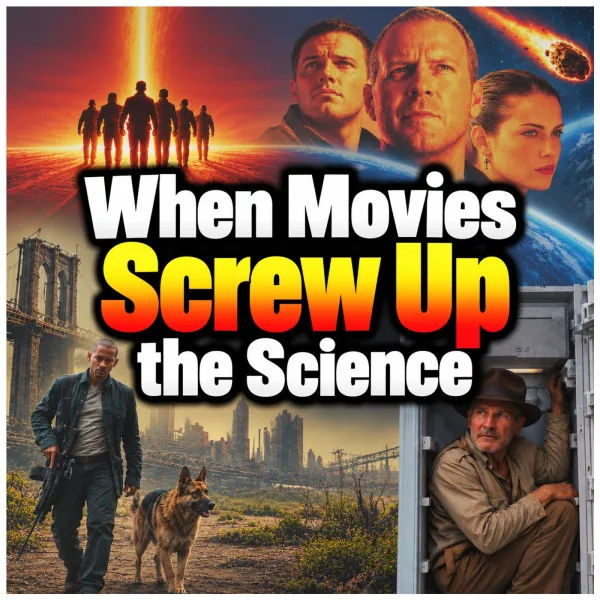
When Movies Screw Up the Science
Timestamps may run a little early on this show. Its publisher adds adverts to the audio as you download it, and everyone gets a different set, so the recording in your player is slightly longer than the one these timings came from. Expect to land shortly before the moment you picked, by more as the episode goes on.
Summary
This episode examines how Hollywood films frequently misrepresent science, from geology and physics to biology and astronomy, often to the point of absurdity. Scientists discuss the most egregious inaccuracies in popular movies while highlighting films that successfully balance entertainment with scientific accuracy.
- Dr. Donald Prothero explains fundamental geological errors in films like The Core and Volcano regarding Earth's interior structure and volcanic behavior
- Dr. Abigail Smith discusses how I Am Legend misrepresents viral biology and the implausibility of contagion-based zombie scenarios
- Dr. Aaron Adair critiques the physics and astronomy errors in Armageddon, including an implausibly large asteroid and impractical astronaut training
- The Science and Entertainment Exchange was founded by scientists including Sidney Perkowitz to help Hollywood avoid major scientific errors
- Films like Contagion, Jurassic Park, The Martian, Interstellar, Gattaca, and 2001: A Space Odyssey successfully demonstrate scientific accuracy alongside entertainment value
- Common movie misconceptions include the ability to remove venom by sucking, enhance pixelated images, and render people unconscious with chloroform instantly
- Gun silencers in films are depicted as nearly silent when they would actually produce triple-digit decibel levels
- The Day After Tomorrow violates thermodynamic laws with impossible air temperatures and hurricane formation over land
Key moments
-
Scientific Errors in Cinema
Seth Andrews introduces the episode's focus on Hollywood's misrepresentation of science, sparked by Godzilla vs. Kong's hollow Earth concept.
-
Geology Gone Wrong: The Core and Volcano
Dr. Donald Prothero discusses extreme geological inaccuracies in these films and explains actual Earth structure and volcanic behavior.
-
Viral Biology in I Am Legend
Dr. Abigail Smith explains why the film's virus-based cure and zombie apocalypse scenario lack scientific basis.
-
Asteroid Physics in Armageddon
Dr. Aaron Adair critiques the film's implausible asteroid size, astronaut training, and appearance compared to actual space missions.
-
Asteroids, Comets, and Climate in Film
Scientists discuss how films misrepresent asteroids, comets, and climate physics, including The Day After Tomorrow's thermodynamic violations.
Full transcript
-
Speaker 1: Here we go. Stand by. Speaker 2: Three, two, one. Speaker 3: The thinking atheist. It's not a person. It's a symbol. An idea. Speaker 2: The population of atheists in this country is going through the roof. Speaker 3: Rejecting faith. Pursuing knowledge. challenging the sacred.
-
Speaker 4: If i tell the truth it's because i tell the truth not because i put my hand on a book and made a wish. Speaker 3: And working together for a more rational world. Speaker 1: Take the risk of thinking for yourself much more happiness truth beauty and wisdom will come to you.
-
Speaker 4: That way assume nothing question everything and start thinking this is the thinking atheist podcast hosted by Seth Andrews.
-
Speaker 2: Today is going to be a nice break from the heavy stuff. We need to mix it up, and we need a distraction. No religion and politics today. Today we're doing science, or more specifically, anti-science, so often seen in movies. Now, don't flip out on me. I'm not trying to be a killjoy, and I understand. We're going on a roller coaster ride. We suspend disbelief. This is escapism, right? We're
-
not going to a college campus to a university lecture and hearing something from a PhD. That's not why we go to the movies. So I'm not trying to be that guy. But there are some movies that present an anti-science angle or plot point or plot hole that is so jaw-droppingly stupid that we say to ourselves under our breath, okay, I'm out. I no longer give you permission to take
-
me on this journey because you obviously hold me in contempt. You know, this is just beyond the pale. It's too far. I can't do it. And I want to talk about a lot of those types of films. And because I've got some buddies in the scientific community, I have asked a few of them to pop into the show to talk about some of the stinkers that drive them crazy.
-
And the cool part is, is that while we are talking about some of the bad science, we're actually going to get educated on some really good and fascinating science. We get to learn some new stuff today. That's going to be awesome. Now, in regard to the films that I'm going to highlight today, we're going to talk about Armageddon, Bruce Willis, Michael Bay film from several decades ago, Ben Affleck also in it, and Lily Tyler. We're going to talk about the core, volcano, a lot of disaster movies,
-
you know, moonfall. Indiana Jones and the Kingdom of the Crystal Skull. We're going to talk about the fridge scene with the nuclear bomb. I Am Legend, the killer virus zombie movie. I guess, were they zombies? I don't know.
-
Whatever they called them, they were like zombies. I Am Legend. We're going to talk about that and more. All of them are not recent movies, so it's not like spoiler alert. If you haven't seen them, that's not really my problem. If you aren't aware of what these films are about because you haven't seen them, I'll give you a basic rundown.
-
But the thing that prompted me to do this show and sent me down this rabbit hole is that I'm still irritated. I'm still irritated over the 2021 Adam Wingard movie Godzilla vs. Kong, which sounds like a blast to kaijus duking it out. Big fight in the middle of a giant metropolitan city using today's special effects. Oh, man, that sounds like big screen material. Let's go get me
-
my ticket. And then I go. And after a promising start, the whole film becomes an insult to my intelligence to the degree that the big fight meant nothing to me. It was absolutely without consequence. I was emotionally divorced from the whole thing. And of course, it was wildly predictable what was going to happen. There is a way to do outlandish fiction, and it does not include telling all
-
of us, all of humanity, that unbeknownst to us, the Earth does not have a molten core, but under the Earth's crust is a massive subterranean monkey jungle. What? Yes, under our feet right now is a place where Kong lives.
-
King Kong can slip through the Earth's crust, and he falls on this ground under the ground, and there's trees and vines and shit down there. It's the Hollow Earth. And this is relatively new to Kong mythology. It wasn't introduced as a concept until King of the Monsters in 2019. Okay.
-
So you and I are asked to dismiss the reality that the Earth's molten core exists. And we have to then embrace this claim that there's an inverse gravity that affects a massive series of subterranean cavities and they emit harmless radioactive power that makes the hollow Earth animals grow huge.
-
And I'm saying, what? What happened to Skull Island? What happened to the original mythology with Kong? And it can be done and has been done many times. If you want to go back to a terrific King Kong movie, 2017. Skull Island is a wonderful King Kong movie. If you are selling the idea that the Earth's mantle is actually a secret monkey romper room, I am going to judge
-
you and hate your movie. This is a problem easily avoided. And it's just dumb. Why would a Kong story involving what is essentially an excuse to have big kaiju monsters fighting in cities, why does that require me to ignore a fact that is so overwhelmingly known and documented that denying it actually removes all dramatic tension from the rest of the story? Yes, it's been years. I'm still pissed.
-
So that's the catalyst for today's conversation. Let's go back even further and talk about the science or anti-science of Jurassic Park. Now, hang on. I'm not going to ruin Jurassic Park. I loved Jurassic Park. Those of us who were there at the beginning, who had not seen anything like this on screen before, and it's easy to take for granted now that CGI is everywhere, technology is everywhere,
-
We've seen a squillion dinosaurs in a squillion different contexts, right? But back in 1993, when the Steven Spielberg film came out based on the Michael Crichton novel, no one had ever seen anything remotely like this. We went to the theater going, how were the dinosaurs? And we came out saying, wow.
-
I mean, they look good even today. 33 years later, the dinosaurs look fantastic. But Jurassic Park is not necessarily a scientific film. So I'm going to say liked it, but you couldn't splice part of a dinosaur genome into a frog or whatever. You would need the entire genome to resurrect the dinosaurs. The big one, I guess, comes in the title of the movie, Jurassic Park. But the
-
dinosaurs in the film are from the Cretaceous period, not the Jurassic period. I loved the velociraptors of Jurassic Park, but where are the feathers? And we knew at the time that the raptors did have feathers. Did you see the photographs? This was just a few years after Jurassic Park.
-
But there was a new discovery in 1998. It was a forearm bone from a velociraptor that was uncovered in Mongolia. You can see these little quill markings where they anchored to the bone with ligaments. So yes, even the fossil record showed that velociraptors had feathers. And it also has to be said that velociraptors were not 6 feet tall and 10 feet long with massive tails. In fact, they
-
were about this size. Of a poodle. But they would still mess you up. You don't want any part of a velociraptor, even at that size. Like a mid-sized poodle. Just picture a mid-sized poodle, except it looks kind of like a bird. It's covered in feathers. And on each hind foot, there's a deadly sickle-shaped claw that could slice
-
you like sushi. Yeah, that's very scary stuff. But it's not accurate to science. Still, Jurassic Park totally gets off the hook with me. I just love the movie. It transported us into a place that was immersive and kind of scary. And it did not take place on top of a hollow earth. So respect is given to Jurassic Park.
-
Next up on my field of films is a movie called The Core. And The Core does have an actual molten earth as part of its plotline, but the film is so jaw-droppingly preposterous that it actually... changed how future Hollywood films were often made, but I wanted to talk to an actual geologist about the core, and so I've invited my friend Dr. Donald Prothero. Hey, brother. How you doing? Great.
-
Speaker 5: Thank you, Seth. Speaker 2: Give everybody your resume real fast. You are a geologist, paleontologist, but just kind of spell it out. Speaker 5: Yes, my training is in vertebrate paleontology, especially the evolution of mammals, but I taught in geology programs now for close to 50 years. And so I teach almost everything in the geology curriculum, you know, for everything from climate change and oceanography and meteorology and lots of other stuff of basic geology as well. Once in a while, I get to actually teach paleontology, but most of the time
-
I'm a generalist. Speaker 2: So in the movie, I mean, did you see it in the theater or did you rent it? I mean, give me the context. Speaker 5: I saw it at rental, yeah. Speaker 2: So the idea is our planet's solid inner core is not rotating. and therefore that affects the magnetic field, which protects us from dangerous radiation from the sun, so we're all going to bake to death. Our heroes, well, first of all, only one scientist on the entire planet somehow knows or realizes this is going on, and then they
-
create some sort of an Earth craft that's going to punch a hole that goes down and sets off a nuke near the inner core. Speaker 5: And that's about as stupid as... It's Trump's idea of finding a nuclear weapon in a hurricane, which is thousands of times more powerful. Nuclear weapons are powerful, but they're on a much smaller scale than things of the scale of the Earth. It's basically scriptwriters who don't know any science doing everything wrong from day one. The starting point, of course, is that the core, in fact, the entire
-
interior of the Earth is completely inaccessible to anything that humans have because the pressures become intense and And the temperature is kind of over thousands of degrees Celsius when you go down just a few kilometers. The deepest that any human-made object has ever drilled into this crust, okay, not the core, the crust, is only about 12 kilometers.
-
And that was a super deep borehole that was done on the Kalina Peninsula in Siberia. And that's as deep as they can go because the pressures and temperatures there melt the drill material at any greater depth. And they've never been able to drill any deeper than that. They've been trying over and over again to see if they can drill through the oceanic cross which is about 10 kilometers thick and there's some possibility they might be able to make that happen someday but still 10 kilometers just barely is a tenth the way down into the crust beyond that the mantle is never going to be accessible
-
to anything humans make and of course the core is out of the question and people don't realize because what's going on of course is that the gravity pressure of the earth means that the more earth there is the more interior earth is above you the greater the pressure The pressure is thousands of atmospheres. You go just down to about 10 kilometers. And so everything is either melted or crushed or both in that depth. So any idea that you could have an air-filled capsule that actually burrows into the material of the Earth's interior is laughable. Because,
-
you know, they try to get partway into the crust. It would crush them right there and then cook them as well. So it's just completely preposterous. Screenwriters who have no knowledge of what they're doing. So if you go online, there's a series of sites where they list the worst geology films ever made. Some of these geology partners will have a movie night, watch these and laugh at them.
-
And this is almost always voted number one worst geological themed movie ever made. Speaker 2: So the scientists in the movie are talking about the magnetic field, but they say the electromagnetic field, which is something different, right? Speaker 5: No, they're the same thing. Speaker 6: They're the same thing.
-
Speaker 5: If they try to distinguish them, they're not. The magnetic field of the Earth is generated by an electromagnet, right? It's generated by the motion of a conductor, which is the iron, nickel, and the core, as it spins around and then, of course, spins through an existing magnetic field, which generates magnetism. And that's why basically any kind of dynamo that makes it generate electricity works. So that's all it is. That's what the Earth is, a gigantic, what they call geodynamo. Conductors spinning through a magnetic field, generating a current, which feedbacks to make a bigger magnetic field.
-
And the entire Earth is spinning. So the core itself is spinning with the Earth, right? It doesn't ever stop spinning. But we know that it actually spins on its own timescale a little bit differently than the Earth. And yet still, of course, the Earth itself is spinning. So that doesn't stop. It never can stop. And even if it were something to happen, if they tried to model what it would do, the Earth's magnetic field would not just vanish overnight. The Earth's magnetic field, when it changes, for example, when it flips, takes thousands of years or something like that, or 5,000
-
years for that just to take place. So there's never going to be a point where there's no magnetic field around the Earth, even when the so-called bipolar field, the one that has the North and South Pole, which is 95% of the field we fail, there's a non-bipolar field behind it that's always there. So even during times the Earth's field is flipped, it does not make the field go to zero. It just has a very weak field and the non-bipolar field takes over. And likewise, all these ridiculous things, especially in 2012, when they had all this crap still being made about how the Earth's magnetic field
-
was going to disappear and everything was going to go to hell. The reverse magnetic field is flipped many, many times, and there's no connection whatsoever with causing extinctions or climate change or anything whatsoever. This field just gets weaker. And the difference between magnetic field that we would feel right now versus, say, during that polarity flip is the difference between the magnetic field you feel between the North Pole and the equator. It's so tiny. So all of this is completely scientific bullshit based on people who don't know anything about geophysics.
-
Speaker 2: Oh, I love the idea that we go down, somehow we get to the core, and then setting off a nuke will not only cause the inner core to rotate in whatever direction we want, but the exact same speed that is required. Like it's a magical nuke, I guess.
-
Speaker 5: And of course, the outer part of the inner core is liquid. Okay, so that's a different game altogether. It's a fluid. We know this because seismic waves that try to pass through the Earth's interior, all the ones that have the up and down shearing motion, the so-called S waves, the second wave is derived in the seismometer. They disappear as they hit the outer bond of the core. And the only way that would happen is if the outer core is fluid. So it's actually not a solid core all the way. It's only solid in the inner part of it.
-
Speaker 2: I know that Emory University physics professor Sidney Perkowitz saw the movie. He was so bothered that he actually came up with a set of guidelines for Hollywood to use to avoid even... Look, try not to embarrass yourself this badly.
-
And he had some other scientists to contribute it. And they came up with a coalition called the Science and Entertainment Exchange, which is like a cheat sheet for Hollywood so that they won't drive Dr. Donald Prothero as crazy when he goes. Speaker 5: Well, most of us are bothered by it. And the only thing that's, of course, happening is that we don't take it too seriously because we know it's sci-fi and a lot of absurdity in almost any sci-fi movie. So, you know, we just assume that other people will. But unfortunately, it is true that a lot of people learn their
-
science from sci-fi and other movies, which are full of garbage like this. So, you know, when we don't get a chance to teach them the truth, because education science is so spotty in this country now, and so no one actually learns what the core is really like, then unfortunately they get the impression these movies are telling the truth.
-
Speaker 2: I thought of you... When I saw a re-release or a stream of a movie called Volcano, where a volcano appears somehow in the city of Los Angeles, which is impossible. Speaker 5: No, there hasn't been a volcano here in 15 million years.
-
The nearest one was over in the Santa Monica Mountains, and it was not a surface volcano, it was an intrusion. Speaker 2: Apparently all the geologists and volcanologists didn't... You know. Speaker 5: What's going on there is that these writers don't know there's just asphalt and lava. They think it's because it occurs in La Brea Tar Pits. They somehow think La Brea Tar Pits is somehow connected to magma.
-
Speaker 2: Interesting that lava in movies always looks kind of the same, where in truth, don't different types of volcanoes produce different types of lava? Speaker 5: That's right. That's right. In fact, they usually don't occur together. The kind of black oozing lava that you would saw in that movie Volcano or what you see in modern footage of, say, Hawaii, is the kind of stuff that comes up close from the mantle. It's called the basaltic lava, and it's very, very fluid. It flows as easily as water, most of it. And it's something like 2,000 degrees Fahrenheit.
-
Speaker 2: Very, very hot. Speaker 5: So you get too close to it, you'll get burned. But the kind of lava that erupts, and actually the kind of eruptions that occur inside the volcanoes we have in most places here in the western U.S., like the chain of volcanoes that makes up the Cascades, those are anisite rhyolite lavas that come from deeper in the mantle when the subducting plate melts. And they have a very different composition.
-
Speaker 6: They're full of silica. Speaker 5: So they're very viscous, like peanut butter, which means they don't flow and make lava flows at all. Instead, what they do, as you think about what happened in St. Helens in 1980, they blow their tops because they get clogged like peanut butter in your throat. They get clogged at the top until the pressure builds up and then they explode and then make huge ash clouds and giant volcanic bombs and all the rest. But they don't make lava flows. And what you see in movies like, for example, Dante's Peak with Pierce Brosnan did this They tried to
-
have a warning of a town that was close to a Cascades volcano, but they threw in every possible volcanic effect, including things that would never occur in Cascades volcanoes. Because all lava is the same to them, and all volcanoes are the same to them, and they have no knowledge that it's more subtle than that. It's because it's all entertainment.
-
Speaker 2: Oh, I remember the scene when they were driving, I think, his pickup truck over lava. Speaker 5: Yeah, well, it would burn the entire truck in seconds. Speaker 2: It would just melt and engulf, and everybody inside would already be in flames. Speaker 5: 1,000 degrees Fahrenheit, actually almost 2,000 degrees Fahrenheit, your car would actually combust as you got close enough.
-
Speaker 2: Awesome. The gas tank, you know, it's unaffected. Yeah. Speaker 5: Everything was easy to melt, like your tires would blow along before you ever got close to it. That would never occur in any kind of a volcano like that. If it's exposed to the Cascades, you never see lava flows in the Cascades. They don't make that kind. They make explosive material, ash and fire, plastics and bombs. And that's what we think about when we think about Man City Helms. were no lava flows in Mount St. Helens.
-
And there aren't from any of those Cascade volcanoes. It's all material that blew out the top and then spread over a huge area. Speaker 2: Not to keep you, but the one thing that would terrify me is that pyroclastic flow, right? It's not the big glowing orange lava, but it's that ash cloud that's burning, and how many degrees it'll just incinerate you. Those terrify me.
-
Speaker 5: Those are actually the deadliest of all. That's right. Well, the people have been killed by volcanoes. It's because what will happen is when one of the explosions occurs, it creates this superheated cloud of gas and dust and ash, which roars down the slope, depending on how steep the volcano is, We're down the slope at speeds greater than 40, 50, 60 mile an hour, depending on how steep it is.
-
And a pyroclastic flow will catch up to you even if you're driving at full speed on the highway in seconds. You can't outrun it. And that's what kills people. When they have monstrous eruptions, pyroclastic flows will go over huge areas, and they will, of course, suffocate and burn everybody who's in it. That's what happened to the victims of Pompeii and Herculaneum. They're all killed by pyroclastic flows. The French word for it is Nuit Ardent, because in 1902, the island of Martinique in the Caribbean, the top of Mount
-
Pele blew off and produced pyroclastic flows that killed 30,000 people in the town of Saint-Pierre in a matter of seconds. They burned the entire town down. The only thing left were the concrete walls. And those are also found in many other places. So there's a famous story of Mount Onsen in Japan in 1991. It was a bunch of volcanologists and people were observing it. And suddenly it let loose a bunch of pyroclastic flows and killed everyone who was too close. including a very famous French couple, the Crafts,
-
who were major photographers of volcanoes all their lives for National Geographic. They made a living doing filming of volcanoes before even that scientist got there. And they were too close to mountains and they also died. Speaker 2: One thing I have learned from the movies, though, that if a scientist in real life comes and gives me a warning... I should at least listen, right?
-
Speaker 5: That is a trope, you're right. Speaker 2: It's always the case. Speaker 5: Scientists are telling various types of people that this is what they should watch out for. It's the same in Jaws, you know, when the mayor refuses to listen to the shark specialist. They always are, this is, the trope of almost all those movies, any kind of scientific topic, an expert comes in and the authorities will always, always ignore it or put it down because they have ulterior motive, usually commercial value of things that they have to protect.
-
Speaker 2: You know, if you show up at my house and you say that all of a sudden you've discovered a volcano under my home, I mean, you've got some props and credibility with me. So I'll probably, you know, I'll have to peer review you on that. Okay. Speaker 1: Dr. Speaker 2: Donald Prothero, thanks so much for indulging me on kind of a fun distraction. I just love to hear you educate about this stuff. I've learned a lot in the last 15 minutes. So good.
-
Speaker 4: All right. Speaker 1: Great. Speaker 5: So good to talk to you. Speaker 2: We got more movies and TV shows. I'm going to start with Gravity next. I will admit that I really mostly enjoyed the 2013 Alphonse Curon movie Gravity. George Clooney,
-
Sandra Bullock. It is really a sensory experience. We caught it in the IMAX in 3D and it was insane and immersive and dramatic and quite good. The general idea is that there's a crew. They're on this orbital mission.
-
I think they're fixing the Hubble or something. And then there's a series of satellite explosions, and those explosions cause deadly space debris to shoot all around the Earth. So our heroes find themselves in the path of about a squillion space shards, little projectiles, and the story becomes one of survival. There's a lot of good stuff. said about gravity by the science community. But there are a few quibbles.
-
Do I honestly think that NASA would have been okay with George Clooney jetpacking and sort of cartwheeling himself around a multi-billion dollar satellite as he was playing his music and telling stories? And it was just, I mean, it was way, it looked like a playground up there. Absolutely not.
-
The spacesuits themselves were missing a few things, like liquid-cooled ventilation, and for obvious reasons, you've got to be able to see the actors. So they had the transparent glass on the helmets, but in truth, to keep from being blinded by the sun, astronauts would have been wearing those solar visors.
-
Scientists say that it would have actually taken years to form that kind of catastrophic satellite debris. And that debris, which was traveling apparently around 50,000 miles an hour, could not have been seen by the naked eye, even by astronauts in orbit. But the biggie, and the one that drives people the most crazy, is this key moment when George Clooney's character wants to keep Sandra Bullock's character from
-
floating dangerously away from the International Space Station. So if I remember, for some reason, I think her leg may be tangled up and could not have supported both of them. George Clooney unclips his tether, and then he just floats away off to orbit until he dies of suffocation.
-
Speaker 1: Okay? Speaker 2: But it's space. It's zero gravity. All he had to do was grab that little cord and give it a tug, and his momentum would have drifted him back to the International Space Station, and he could have finished the movie with Sandra Bullock. Now, there's some scientific debate about gravity.
-
A few NASA engineers have had discussion about this. They said while the two characters at the time were actually decelerating, Sandra Bullock's character had her legs stuck in parachute cords. Those absorbed her kinetic energy. They were not strong enough to handle George Clooney's kinetic energy as well. So George disconnected to keep those cords from snapping. I'm not a scientist,
-
but this does not satisfy me. It doesn't feel right. Just tug yourself forward. Just move forward. Just Just one little gesture. Boom. You're all set. You're saved. And then you guys can finish the film together. You can survive together. Still a good movie. Still an intense movie. I own it on Blu-ray. If you do watch it, make sure you've got a great big screen and a killer sound system.
-
You're going to be well ahead of me on this one, but how can we talk about the movies that insult us with bad physics without talking about Indiana Jones and the Kingdom of the Crystal Skull and the fridge nuke? I was so insulted that I almost just laughed. I mean, you don't need the plot of Indiana Jones. All you have to know about Indiana Jones and the Kingdom of the Crystal Skull, you need three things. You have to
-
know there are CGI monkeys, there are aliens, and there is a scene where Indiana Jones is fleeing the Soviet agents and he wanders into the middle of this sort of simulated town during an atomic bomb test. And they used to do this. They would put together what they called doom towns. And they would put mannequins in them and various structures and buildings in the vicinity of a
-
nuclear test. And they would then observe what the catastrophic fallout would be, if any. What would the explosion do? How would the radiation fall? Et cetera. So it's rooted in a real thing that happened in the 50s. But in the film, Indiana Jones, he's on the run from the Soviet agents, the big bad guys. And he looks around and says, where the hell am I? This is a weird town, empty of real people, but filled with mannequins.
-
And then he hears the timer of the atomic bomb, and he realizes what's about to happen. But he spots his salvation. In the kitchen of one of the homes is a big refrigerator that has a lead lining. Indiana Jones empties the fridge, and he jumps inside. He closes the door. The bomb goes off. BOOM! And that refrigerator gets blown out of that decimated house, and it goes
-
on a kind of violent pinball tumble that would have probably liquefied Indiana Jones. Look it up on YouTube. Look it up on YouTube. I'm sure you can find the scene. It is unsurvivable to a laughable proportion. Fatal internal trauma.
-
And the physics of the tumble doesn't even take into account the heat of the bomb, which almost certainly would have melted the fridge, and then you've got all of the radiation and the after effects. Steven Spielberg was trying to cover a little bit for the writer of Crystal Skull, George Lucas, who... Let's face it, it has not written or produced anything of real value since the 80s. And I will die on this hill. There's a great documentary called The People vs. George Lucas, and we must give
-
accolades and respect for what he has accomplished in his life. But he's not a good writer, like he flashed early with brilliance and since then... It has been shit like Indiana Jones and the Kingdom of the Crystal Skull. But Steven Spielberg, facing all the criticism from people saying, what in the hell are you guys thinking? He was like, well, you know, it was kind of a tandem decision to have that scene. George Lucas himself came forward. and said,
-
Steven Spielberg is just trying to be kind and give me cover. He directed the film. I am the one who wrote and included the nuke scene with the refrigerator. The responsibility is mine. That scene in this movie is so bad that it spawned a new saying for when something really far-fetched happens. People say, nuking the fridge. And this reminds me of jumping the shark. Some of our
-
younger viewers may not know. You may have heard people say, well, that's when the show jumped the shark. And that comes from the old TV series Happy Days. And the Fonz was one of the most popular characters on television. But Happy Days became more and more like out there and outlandish and cartoonish. And there was an episode where Arthur Fonzarelli, the Fonz, dressed in a leather jacket. His signature leather
-
jacket with a life vest over it is on water skis. And he jumps a ramp over an actual, I think it was a great white shark. And it was a two-parter. He goes up in the air and they show his skis.
-
He's airborne, the shark underneath. Tune in next week for part two. And the show had gone so far off the rails that that's what people mean whenever they say, this jumped the shark. It's just too far. It's a bridge too far. It is too outlandish. And now, thanks to Indiana Jones, if we see something do the same, you can say it nuked the fridge. By the way, did you know that that nuke refrigerator scene was not
-
originally written for Indiana Jones? It wasn't. The first draft movie script, which actually had this scenario, involved a time machine that was housed inside a refrigerator, and the way to power the time machine was that it had to be near a detonating atomic bomb. So there was a nuke and there was a fridge, and this might have actually worked, had it made it past the first draft
-
script of Back to the Future. I don't know. I don't think you can do Back to the Future without the DeLorean. Will Smith. We talked about him after the Oscars when he went up and slapped Chris Rock and then won an Oscar and then was banned from the Oscars.
-
That's the one Will Smith story that enters my mind. But before that, people like to talk about the movie that he starred in called I Am Legend. In this film, scientists attempt to cure cancer using a virus. Things go awry, and pretty much those who are not eradicated become nasty little mutants called Dark Seekers. But our hero apparently is immune and wants to use his own blood to, I don't know what's going on. I want to talk to
-
somebody who does know what's going on about I Am Legend. So I'm bringing on a researcher who studies viruses and immunology, friend of mine, Dr. Abigail Smith. Thanks for coming. Speaker 1: Oh, thanks for having me. This is always fun to discuss. Speaker 2: Can we use a virus to kill disease probably is the question that comes to my mind.
-
Speaker 1: 100%. And we actually are trying to do that like they do in the movie with measles. So it turns out that we can take the vaccine variant of measles. And it is by itself naturally oncolytic. It prefers to replicate in tumors because tumors have the receptors on the surface that the virus really likes. So what ends up happening is that these anti-cancer measles viruses will go straight
-
to that tumor and will start, for lack of a better term, eat it. Speaker 2: So what are the odds of us creating a cure that turns out to be an injection of extinction? Speaker 1: So 100%, this is something that scientists think about. The measles virus that I was talking about that could kill tumors is naturally killed by your own immune system. But what we also do, scientists will put in like switches,
-
like emergency breaks, where we can give people a specific drug and that will shut off that virus completely. And what we're actually worried about from our perspective is inadvertently causing a cancer in a person as opposed to inadvertently making a person a zombie.
-
Speaker 2: So as you're watching Wilt Smith's character, who is, he's the guy who's immune to And he's going to use his own blood to find a cure. What makes you groan? What makes you just want to claw your eyeballs out when you're watching I Am Legend? Speaker 1: Well, first of all, it propagates another trope, which is the lone scientist. Science is not a singular goal. It is a goal that's shared not only between labs, between institutions,
-
between countries. It takes lots of us all around the world to solve a problem like, let's say, a zombie virus. It is not one guy hanging out in New York who can do it on their own. So that's one of the main things. So this problem only comes up in the theatrical release ending where Will hands off a vial of a cured zombie's blood so for them to figure out the cure in the outside world. Okay, I'm
-
trying to even conceivably think of how this could work. I have ideas as to scientifically how this could work. But to a degree, it mirrors what we actually do do in the clinic called convalescent plasma therapy. So we did this during COVID when we had nothing for people who were experiencing severe disease. And so what we did is we took plasma from people who had recently resolved
-
the infection in themselves. And we purified that plasma, purified the antibodies and gave those antibodies to someone who is really sick. So you can do that. It requires a lot of blood, a lot of plasma for one treatment.
-
And he hands off this bitty, bitty vial. I think it's five to 10 mils of blood. That's not enough for even one treatment. It could be that there are antibodies in that vial. First of all, it would be luck that you happen to have the right antibody in that one vial, or you would happen to have the right B cell, so B cells make antibodies in that vial.
-
So in theory, you could sequence that antibody and then synthesize it as a protein that you could inject into individuals. And so we do do something kind of like that now called monoclonal antibody therapy. And so we have lots of therapeutics today that are an antibody. Again, those are the end result of decades and decades and decades of research and clinical trials. We don't just take a vial
-
of blood from someone to reach that end goal. And also that treatment would again be transient. So it's only as good as long as that antibody stays in your blood. Well, I mean, your liver and kidneys will eventually filter out all those antibodies that have broken down and you won't have permanent immunity. The only way to, in my opinion, have permanent immunity to the virus they created is the MMR vaccine.
-
Speaker 2: Is there a possibility that there is any scenario where some virus could turn us into zombies? So I mean, certainly you guys talk about this at lunch, don't you?
-
Speaker 1: Even, you know, let's say rabies that in other animals creates, you know, that sort of zombified personality. That's not the way rabies behaves in humans. So I guess if evolution isn't true and, you know, we're more raccoon-like, individuals are more raccoon-like than other humans, then perhaps that could... All right.
-
Speaker 2: So like 28 days later, we would not be infected with rage like the monkeys were in the lab. Speaker 1: I simply know of no mechanism by which a virus could lead to such a dramatic personality change.
-
Speaker 4: Dr. Speaker 2: Abby Smith, when we hear virus, most of us kind of cringe. Uh-oh, sickness, virus. I say virus to you, you get excited. What's that about? What's that about? So first of. Speaker 1: All, I just find them fascinating in and of themselves. Viruses behave in such a different way than big creatures like us, like humans, like whales, even like bacteria. They have followed the path of evolution to be creatures that can tolerate so much diversity in their genome and tolerate mutations.
-
And so just from a scientific level, it's really exciting to study how those changes affect the virus and change how our immune systems interact with the virus. So we've actually learned a lot about our immune system by, let's say, understanding what all the different genes do in HIV and how they evolve over time. They're also interesting, again, because we can capitalize on them. We can tame these viruses
-
to be used for our benefit. We have the technology in 2026 to make vaccines, to make these oncolytic viruses and genetically modify our T cells to cure cancer. We can do so many cool things with viruses.
-
Speaker 2: All right. If there was a science-based movie and it's virus-based or not, is there one that's closer for you that you think, okay, at least they gave it a try? Is there anything? Speaker 1: I think we'd probably have to give that to Contagion, the one with Gwyneth Paltrow and I think Matt Damon.
-
And again, I think it's more, again, the way humanity reacts to that situation that was accurate in that film. Speaker 2: I think you and I probably agree. There's this notion that when things are at their worst, that's when humans are at their best. And I'm not convinced that's the case.
-
I think people panic. and they grab all the shit they can, and they buckle down, and they locked out the rest of the world, with some exceptions. But I'm not convinced that an I Am Legend scenario would bring out the best in all of us as survivors. Am I just being a cynic, Abby?
-
Speaker 1: I'm with you. And that's being said, I am surrounded by physicians who sacrificed so much during the last event. And how quickly things went from banging on pans at 5 p.m. to show your appreciation to them getting attacked and just burnt out and the way they were treated.
-
And I think those kinds of people are always going to exist. And thank goodness for them. Speaker 2: Any final thoughts, Abby, on viruses or anything that's rooted in the film or in the real world that you'd like to punctuate our chat with? Speaker 1: You know, I'm just really excited that, you know, I always say this. I love living in the future, how we're able to do all of these cool things in the lab, like the gene therapy, like some really cool vaccine modalities we have in the pipeline. It is just
-
so fun to be a scientist right now. Speaker 2: Imagine going back 100 years, hell, even 50 years and saying this is going to be on the table and this is going to be in development. It would blow people's minds. Speaker 6: Absolutely. Speaker 2: Cool. Dr. Abby Smith, thank you so much for being a part of the show. Appreciate you.
-
Speaker 1: Thanks for having me. Speaker 2: More cinema, more science, and a few films that really got the science pretty close. Lots to do after this.
-
Next up on my list of films with sketchy science, how in the world can we do this show without talking about Michael Bay's Armageddon? Well, I don't want to talk about physics without speaking to a physicist, so I have brought on board Dr. Aaron Adair, who is a physicist and data scientist, and he has thoughts. Aaron, how you doing, man?
-
Speaker 7: I'm doing okay. Speaker 2: I'm doing okay. I see in my mind there's Several scenes, but the one that really blows my mind is when they launch both shuttles to go and intervene and set off the asteroid nuke. And the shuttles take off at the exact same time. and they're sort of spinning all around each other like they're doing an air show. And in my mind, I'm like, okay, what's the dollar figure per shuttle? And what would NASA actually say about this
-
sort of sexy butterfly dance that the shuttles are doing as they exit Earth's atmosphere? And I just think, how stupid does Michael Bay think we are? And the answer is, very stupid, or he just doesn't care. But I want to talk to you about the stuff in Armageddon that makes you crazy as a scientist.
-
Speaker 7: Well, how about the beginning and the end? Because that covers everything, doesn't it? Speaker 2: So the movie, I get that the movie itself is an answer, but I'm going to need more from you. What drives you crazy? Speaker 7: I mean, specifically material at the beginning and material at the end that will show you just how much of a lack of attention there was to try to get the science right. So for those of you who have not seen this movie from the late 90s, it's not even the only asteroid movie from that same year. Deep Impact, I think, came out within like months of that. I'm
-
not saying Deep Impact was the science-minded correct one, but better. Nonetheless, the way Armageddon begins is this amateur astronomer with his backyard telescope basically discovering an asteroid coming towards Earth that's the size of Texas. And somehow he's the only person in the entire world who noticed this thing and has to call up NASA and say, hey, look at that thing.
-
That ain't happening because, one, that is not just big for an asteroid, not just huge for an asteroid, but just out of this world in the sorts of sizes of rocks that we don't know about floating around through the solar system. Speaker 2: How big would an average asteroid be if it's not the size of Texas?
-
Speaker 7: Well, let's put it this way. There are four asteroids in the asteroid belt that we call almost moon-size, but the vast majority of asteroids are meters or even less than that in size. Recently, the couple of interstellar asteroids or comets that came through like Omoromora, 3I Atlas, they were on the order of hundreds or thousands of feet across, while the asteroid from Armageddon is supposed to be something like a thousand kilometers across. So, yeah, we're orders of
-
magnitude off from what we normally would check. And of course, when something's big, you kind of notice it. We would have probably seen this months, if not years in advance. So that's already like, you know, the starting premise of the movie already has me saying, nope, nope, no, that's not how this goes.
-
Speaker 2: And the idea is we're going to take oil rig workers because we need to be able to drill into the asteroid to drop a nuke. Totally plausible. Speaker 7: Well, let's say that among the issues you would have is how long does it take to train up someone to be an astronaut and have them be competent in zero G and handle also nine G maneuvers and all the other things that they have to do before doing anything else. It's not a matter of a couple of
-
weeks to put it extremely mildly. So first off, doing all that, and also folks that aren't exactly well-suited for space. I mean, heck, one of the montages from the movie is to show just how unsuited these people are to be astronauts. Yep, yep, these are the ones that will save us from the end of the world, of course, of course. While I do believe Steve Buscemi can do lots of amazing things, this is not one of the things I believe he can do.
-
Speaker 2: I'm sorry. As I'm watching this whole idea of setting off a nuke, I was thinking to myself, well, if it's in space... Couldn't you just set off some sort of an impact in its path or adjacent and just bump it? Like, wouldn't the force of an explosion kind of just nudge it?
-
Speaker 7: If we have sufficient time, a small nudge would be sufficient for it to avoid hitting the Earth. But they're trying to set this up as like, oh, no, it's way too close. Speaker 2: It's coming in. Speaker 7: It's too big. It's not possible to use anything else other than blow it into pieces and have the pieces shoot by the Earth instead. They're trying to set that up and I'm like, okay, I'll grant it considering you've already put us into this position, no matter how impossible it might've been that we got there in the first place.
-
But of course, then you have to land people on there, which is a very non-trivial thing. We have landed probes on comets more recently, but that was also difficult and we didn't have to do it on the constraints of do this or it's the end of the world. You know, no pressure, no pressure. And also the things that we landed on that asteroid include somehow jet packs on it, which like blow air, which shouldn't be on an asteroid because there's not enough gravity. So that way they can
-
still walk around there. And also there's fire, there's explosions. Speaker 2: So in the film, the asteroid, it looks kind of sexy, like a fortress of solitude on crack, a lot of jagged blue ice crystal type places, right? And I'm thinking, what would the asteroid actually look like in real life?
-
Speaker 7: Probably not that, in part because the asteroids are largely made of rock and metal. Having this ice there is more comet-like. And the fact that they are showing the asteroid having the trail like a comet, they're mixing up things there. So if there were ice there, it would probably be water ice, dry ice, maybe some nitrogen ice.
-
The exact combination it might be is something yet for science to fully determine, all the more so if it's an interstellar body. Speaker 2: But. Speaker 7: Yeah, it probably would not be a bunch of sharp, jagged things like that. Like I say, we've actually landed on comets and we see what it looks like. And it almost looks like a blizzard wonderland of wintertime.
-
Speaker 2: What have we done when we landed on the asteroid? It seems like we set off some sort of a detonation, right? As an experiment when we landed on a comet? Speaker 7: You might be mixing that with another mission because there was the Philae mission where we actually had a lander. And then there was what was called the DART mission where we actually sent impactor on purpose. This was actually two asteroids orbiting each other. And this was actually a test of a defense mechanism for Earth. The idea is
-
we can hit one asteroid and we can see how much it deflects it from that impact by seeing what happens to the orbit of these two bodies around each other. And since they're orbiting, we can do lots of good measurements. So this was an experiment to basically see, hey, if we use impactors, will that save the world? And that was the DART mission from a couple of years ago at this point, and successful mission, I should say. It was actually even more successful than expected.
-
Speaker 2: I just realized I did it. I said asteroid and comet in the same sentence. All right, here's a dumbass civilian question. What's the difference, asteroid, comet? Speaker 7: Main difference is asteroids are rocky and metallic. Comets tend to be, the old term is dirty snowball, combination of dry ice, water ice, dust, These are the things that when they get close enough to the Earth that they start to sublimate and make these long, beautiful tails of debris in the sky.
-
Speaker 2: Before I get to the finale, which I know is probably your favorite part of the story, what would happen? They took a pistol onto the shuttle. What would happen if you fired a gun in space? Speaker 7: Well, there's a few issues that could be there. I mean, you can have bullets firing if it like brings its own oxidizer. So like, it's possible to shoot some kinds of ammunition underwater because you need.
-
Speaker 4: That, right? Speaker 7: But yeah, for the most part, you just can't take an average gun and expect it to work. Not to mention, are you going to hear it firing? Probably not. It's not going to cool down very well because it's not going to have air and other sources to cool it. So you definitely don't want to say, I don't know, Gatling guns on a space vessel just shooting off.
-
Speaker 2: Okay. Speaker 7: You're going to have some engineering problems, to put it extremely mildly. And also, yeah, why are you taking guns into space? Speaker 6: Please. Speaker 2: All right. Well, take me to the finale, the big ending, right? Throwing a nuke down under the surface to, I want to say it was 800 feet, and that's going to solve the problem. Spell it out for me.
-
Speaker 7: Yeah, the idea, get a nuke to the core of the asteroid, explode it, and that will then split the asteroid in two, and then the two halves shoot onto either side of the Earth rather than having a direct impact. Speaker 1: Okay. Speaker 7: Now, because a bunch of scientists decided to watch this, and we listened to the theme song, which told us, you don't want to miss a thing, we pay attention to all the details, and we are able to say, all right, the asteroid is this big, it has this sort of density, therefore it has this mass, it's coming in with this speed, so how much energy is it
-
going to take to actually explode this thing into two paths and have it miss the Earth? Speaker 6: And again. Speaker 7: Scientists be scientisting, and we run the numbers, and no, a nuclear weapon is not going to do the job. In the same way, if you took a nuke and put it in the middle of Texas, would it break Texas in half?
-
Speaker 2: Probably not. Speaker 7: And if you try running the numbers, the bare minimum of what you're going to need isn't one nuclear warhead, but one or two billion of the largest nuclear bombs we've ever had. And if you are detonating that many at once, pretty close to Earth, you are actually having something with a similar output to the sun. to blow this asteroid up so yes congratulations the asteroid mess downside is half the earth is permanently.
-
Speaker 2: Irradiated okay well before i let you go deep impact is i really enjoyed deep impact especially against armageddon it just felt a little more i hate the word grounded in this context but it was i was more emotionally involved do you feel that way at all about deep impact you said it Some people consider it more scientifically accurate.
-
Were you being facetious there? Speaker 4: No, no. Speaker 7: It's generally agreed that it's, compared to Armageddon, definitely the better of the two on the science side. Not that it's a documentary in quality or anything like that. But among the things is, hey, what would it look like if an asteroid did hit specifically the oceans of the Earth?
-
And the oceans are more likely to be hit than the continents because there's more water. And then seeing the giant tsunami that that would produce, and then the destruction of the East Coast is relatively close to what you would expect from the numbers that go into there. I haven't run the numbers myself, but it's much more plausible. Also, this movie had not one, but two asteroids, and they did try firing the entire nuclear arsenal at it, and it failing, which is also probably the case. Just a bunch of nukes last minute being thrown at it. It's
-
a desperation move that it probably wouldn't have worked. So yeah, they... They did a lot more. And while, again, I said I don't think Steve Buscemi could have saved the world, I do believe Robert Duvall could, and he did. Speaker 2: Duvall could have saved the world. Dr. Aaron Adair, kind of a fun show, a fun conversation. It's nice to be able to hang out and just talk about, I don't know, lighthearted stuff, going to the movies, right? And we can enjoy Armageddon without totally being, but I prefer deep impact. I'm a snob, I guess, in that way, Aaron.
-
Good to talk to you, brother. Thanks for playing along. Pleasure. Speaker 6: Thank you. Speaker 2: Around 2004, Roland Emmerich was due to release yet another vacuous CGI special effects fest with a thin plot barely threaded through it. So we saw the movie The Day After Tomorrow, which was all about the dangers and the consequences of global warming, leading our planet into a new ice age. The movie is big. It is big budget.
-
It has massive, massive, grand-scale, huge screen special effects. It also, according to scientists like Dr. Andrew Weaver, who is Canada's top climate modeler, that film violates every known law of thermodynamics.
-
The plot is what we have come to expect. There is a single climatologist, one guy who has figured it out. Everybody else is clueless. But our climatologist hero, played unconvincingly by Dennis Quaid, he discovers that shit's about to go down. Uh-oh, there's a cycle going on. 10,000 years ago, we saw a sudden climate cooling on this planet. It's time again
-
for the Earth to go glacial. And it is our behavior on this planet that has accelerated and very much amplified the effects. Human-caused global warming will melt the polar ice caps. and they will dump enough fresh water into our oceans to disrupt the Gulf Stream ocean current. This will create super storms and unleash worldwide weather chaos in a matter of hours. The theory itself that this is
-
loosely based on, that's actually a real theory. There's a name for it. But scientists have been quick to point out that, okay, well, even if the Gulf Stream was pumping warm tropical water into the North Atlantic, the average temps in Europe and North America would cool about five degrees, maybe, and that would take many years. In the movie, the eye of the storms, these massive storms that are snow and ice storms, Hurricanes made of snow and ice. In
-
the eye of those hurricanes is air that is minus 150 Fahrenheit. It dramatically drops and freezes everything from helicopters to human bodies. But the truth is, the air in the troposphere is only minus 75, so that's half that.
-
And there are physics laws. One is called the Ideal Gas Law, which I think is awesome. The Ideal Gas Law. That dictates that if the air descended like that, it would actually grow warmer, not colder. It is also impossible for hurricanes to form over land, and, of course, hurricanes cannot produce snow and ice. There's a dramatic storm surge that happens in the day after tomorrow. The ocean rises
-
like 25 feet in a matter of seconds, the surge itself 300 feet tall, destroying everything in its path. But a drop in global temperatures would actually cause ocean water not to expand, but to contract. Glacier growth would actually lock up much of the ocean water. And that makes the tsunami scenario absolutely illogical. On top of that, if you really did want to produce a 300-foot-tall tsunami, you
-
would need wind speeds of over 1,200 miles an hour. That is three times faster than the highest winds on Jupiter. The day after tomorrow, it actually was kind of a flashpoint for larger discussions about the usefulness of bad science in movies if they get people talking about very real issues like human-caused climate change. Okay, it's crazy, it's vacuous,
-
it's stupid, it's bullshit, but if people are talking about climate change... is their merits. I know a lot of people were happy that the scientists in the film were heroes, right? Nice to see that. And there is a through line of international cooperation in the face of global disaster. That's kind of refreshing. But for me, it's just another Roland Emmerich movie, and I still have not forgiven him for
-
Godzilla 1998. Kill it with fire. Oh, look, it's another Roland Emmerich movie. 2022, this came out during the pandemic, called Moonfall. And it was made for $ 146 million and made about a buck and a half at the box office. Now, I never saw this film about the moon suddenly leaving
-
its orbit. But as I understand it, here's the deal. Apparently, long ago, aliens built the moon as an interstellar arc. The moon is hollow, and the purpose of the moon was to seed life on Earth, but then apparently an AI swarm or an alien swarm began siphoning energy from the moon, which caused its orbit to destabilize, and it
-
started to drift toward planet Earth. But fortunately, our heroes are somehow able to go and restore the moon's gravity so that everybody on planet Earth doesn't die. The only upside, apparently, in Moonfall is there is a cat featured, and that cat's name is Fuzz Aldrin, and I think that's rather clever.
-
I want to talk about medical films and medical television shows, and I want to talk to a doctor about that stuff, plus some science-savvy films after this. I want to talk about medical shows, whether it's television or film or whatever.
-
Fortunately for us, I have a friend and fellow activist, Dr. Angela Matke, who has been sort of a face. How long have you been kind of bouncing around the movement? It's been at least a decade, right? Speaker 6: Oh, goodness gracious. It's been so long. Ever since I walked past the skeptic track at Dragon Con.
-
Speaker 1: I don't know. Speaker 6: It was probably around 2008 or something. It's 18, about 18 years ago. Speaker 2: I hear Dragon Con's amazing, but I've never been. So one day. Speaker 6: We're trying to get you there, Seth. Speaker 3: One day. Speaker 6: You've appeared virtually. One day. Speaker 2: You've appeared virtually. Well, I'm trying to balance, you know, having some fun, doing some science, not being a killjoy, but I know... Doctors, nurses, people in the medical profession
-
see your profession represented in ways that make you crazy. Just take me where you want. Is there a film? Is there a show? Speaker 6: Well, there are some pretty common tropes that end up leaking into the emergency department. I'm a practicing emergency physician for, oh, goodness, I don't even want to say how many years. I'm over 20 now. But one of the ones that is the most frustrating for me is the old head injuries.
-
So we'll have patients who come in saying, I didn't want him to go to sleep. I didn't want to go to sleep. Because on TV, that's what they say. Don't let him go to sleep. Don't let him go to sleep. Of course, let them go to sleep. injured brains need sleep. That's the best thing for them. Just wake them up. Make sure that they can wake up.
-
Speaker 2: There was an old MASH episode, and I think it was Hawkeye who had a head injury of some kind, and he was in a South Korean home, and he was begging them, don't let me go to sleep. So he kept talking and talking and talking and talking because the idea was if he was to close his eyes and go to sleep or lose consciousness, that's death.
-
Speaker 6: That's the trope. The thing is, sleep is when the brain recovers. That's when it recycles the neurotransmitters. That's when it cleans out the cerebrospinal fluid. So sleep is good for a brain that's injured. You do want to make sure that you can wake the person up, but it's also very important to let them sleep. That's how the brain recovers.
-
Speaker 2: What else you got for me? What else is on your list? Speaker 6: Well, I mean, in that whole vein of head injuries... I've been watching Slow Horses, which I'm a huge fan of. But there's a trope that they used, the trope where you get knocked on the head and then you're out for as long as the script requires it. And then they wake up and they're immediately back to whatever their activities were. And that's not how head injuries work. If you're unconscious that long from a head injury, number one,
-
there's no way you pop back up to normal within that episode. That just doesn't happen. Number two, they need to go to a hospital because that is a very, very serious head injury. And they will probably be admitted to the hospital if they're unconscious for that long. Speaker 2: Angie, I'm running through the list of medical shows in my brain, obviously, from decades ago. ER, and then we're talking about The Pit. Everybody's like, it's so realistic, The Pit.
-
Speaker 6: It really is, yeah. Speaker 5: Is it? Speaker 6: The Pit is, yeah, The Pit is the most realistic show I've ever seen. Speaker 2: Wow. Speaker 6: Yeah, I was at the American College of Emergency Physicians meeting where Joe Sachs and Mel Herbert and Noah Wiley did a talk. And it was fantastic. Mel Herbert runs MRAP, which is where most of us get our continuing medical education, and worked very closely with Joe Sachs, who's the medical advisor.
-
And they have constructed a set that is extremely realistic, and they've constructed storylines and patient information that is exactly like patients I see. I should get continuing medical education for watching that show. Speaker 2: Whenever I see medical shows, especially medical examiner shows on television, The medical examination room is always sort of lit like a rave. It's super dark except for a sexy light in the middle right over the body and some blue
-
neon in the corner or something. It's sort of like cops. It's like firefighters. They make it look kind of sexy, but it really usually is not. Speaker 6: No, it is not sexy. Medicine is not sexy. Speaker 2: It's fluorescent lights and tubes and bodily fluids.
-
Speaker 6: It's smelly. Yes, exactly. It is bright lights and performing a procedure in such a dim environment would be really, really unfortunate. Speaker 2: Anything else that the media does when it comes to doctors? Speaker 6: Oh, my gosh. I've got a whole list. Oh, hit me. Well, there are a couple of them that really stick in my craw. So I mentioned the head injury one. That one drives me a little bananas. And then another one that I remember seeing a moment or two of. I'm
-
not a huge fan of slasher films, partly because they're stupid movies. like medically stupid, but like, you know, cause just things don't look like that generally. But there was a moment in, I think it was last half to the house to the left or something like that, where someone stabbed a woman in the right lower quadrant of the abdomen and then the left lower quadrant of the abdomen.
-
And then she immediately spits up blood. And that's not how that works at all. Speaker 2: I saw an older show. This is so eighties, but there was someone who got stabbed with a switchblade in the stomach and they were dead in 12 seconds. And I'm screaming at the television. I'm like, no. First of all, we don't know that it's a fatal wound. Secondly, it would probably take potentially days, you know, if they clip something, right?
-
Is that, am I close? Speaker 6: Yeah, no, you're right. Although, although, okay, there are some caveats. If you get the aorta, they can bleed to death pretty quickly. I would say, you know, within a couple of minutes or a little less, actually, depending on how severe the cut is. If they cut the heart, like, because you can get to the heart from the abdomen.
-
It just has got to be kind of high and at the right angle. You can die fairly quickly from that. I wouldn't say in seconds, but, you know, minutes. Speaker 2: Rambo 4. Of course, we don't watch Rambo films for realism. I know. Speaker 4: I know. Speaker 2: But he gets shot in the shoulder. with a high caliber weapon. And in television and films, you get clipped in the shoulder. That's the wound that you want because you can still go out and kill the bad guy
-
and save the day. And I'm like, well, how many bones are there? How many arteries are there? You get shot in the shoulder. You're screwed, aren't you? Speaker 6: There's vital structures there. And bullets don't take a direct course. They tumble. So they could literally end up in many, many places that are vital in the chest.
-
Speaker 2: Any other classics that you want to address? Speaker 6: Oh, the jack-of-all-trades sort of doctor. That's not... I mean, like the Dr. House kind of situation where you'll have one team member who does the MRIs, who does cystoscopy, like putting cameras into the bladders, who does all the emergency care. Like, that's not how... medicine works. It's highly specialized and you're pretty much guaranteed going to yoink me out of the show. I mean, I can buy, okay,
-
I'll buy the premise. Sure, Superman can fly, whatever. But when you're setting something in a very realistic situation, when you throw that kind of unreality in, then I really get, I get very peeved. Doctors having relationships with patients and With other staff members, I mean, that's grounds for firing or, you know, for losing their license. It's so unethical that it just doesn't happen that frequently.
-
Speaker 2: Oh, come on. Come on. Doctors and nurses and staff. Come on. Speaker 6: Do not get your medical information from Grey's Anatomy. That does not happen. Speaker 2: Because if you watch the media, I mean, everybody, I mean, they're in close proximity. They're working together. People are doing people, aren't they?
-
Speaker 6: Not in the hospital. Speaker 5: Yuck. Speaker 6: I mean, I'm not saying it never happens, but ew. Speaker 2: I hadn't really considered the sanitary aspect of it. Then now I'm all grossed out. Speaker 6: As well you should be. As well you should be.
-
Speaker 2: So was there anything else on your list? Speaker 6: I mean, there are some things that I can buy, but, you know, like CPR success rates are grossly overstated. Speaker 2: Now, let me stop you there. Is mouth-to-mouth bogus? I know that chest compressions are legit, but I've heard that mouth-to-mouth is not even done anymore.
-
Speaker 6: Well, it's not that it's bogus. It's that there's enough oxygen reserve within the blood itself that if you could just get the blood moving, then the breathing for someone is less helpful. And people are more reluctant to do it.
-
Like they don't want to do the mouth to mouth part of it. So it's better to do something they're willing to do. The pump and blow thing is now just the pump. So we would like for people to do the blow part. But if it's somebody that is either alone or somebody that you don't know or you don't feel comfortable doing that, we would rather them do something rather than nothing.
-
Speaker 2: Well, Doc, wait a minute. Aren't they blowing carbon dioxide? I mean, they're not blowing air air. Speaker 6: Well, it's got some oxygen left in it. There is going to be a little bit higher percentage, but there's still a lot of oxygen left in it. Speaker 1: Okay. Speaker 2: All right, I'm learning. Speaker 6: And a little bit of oxygen is better than no oxygen, which is why just getting the blood circulating, you're still going to have some oxygen remaining in the blood. So it's better to do something than nothing. And if we
-
can just get people to do something, then you can still save a life. I mean— call 911 too. But getting that blood moving is the most important thing in that situation. Speaker 2: Angie had a longtime friend who was a fireman, fire captain, and the stories he would tell over dinner. Oh, my God.
-
He would be talking about something that he had encountered, and I'm like, I'm sorry. They stuck what inside what in their bodies? I'm sure you and your fellow medical professionals are like, you don't come to a point when you've seen it all.
-
Speaker 6: Well, that's actually a really good point. You think you have, and then somebody surprises you. Yeah. idea that would do that but that's my favorite phone call to make to a specialist though is you know you're not going to believe this but i have this patient who dot dot.
-
Speaker 2: Dot yeah dot dot yeah so beyond the pits is there a medical tv show or film that you. Speaker 6: Like scrubs scrubs in the pit are the two most true to life those are the most realistic. Speaker 2: And as far as like hailing back to ER, is there a George Clooney type in every emergency room?
-
Speaker 6: I don't know that I've ever seen doctors that good looking. But I'll say ER was really quite good. Joe Sachs, who is the medical director for the pit, he was also the medical advisor for ER and tried very hard to keep them on track. I loved ER and enjoyed it very much. Now, they did have problems every now and then. They'd break scrub and stuff like that or break sterility. But there's some of that I can just kind of let slide because you're still making a show.
-
Speaker 1: Yeah. Speaker 6: So it's not a documentary. So you're trying to make a show, and sometimes it's just difficult to– you have to take dramatic license. Speaker 2: See, we're not total killjoys. We get it. Speaker 6: No, not at all. Speaker 2: We get it. Speaker 4: I get it. Speaker 6: I already said I'll buy Superman Can Fly. Yeah.
-
Speaker 2: Dr. Angela Matkey, thanks for spending a few minutes with us talking medicine and thanks for the work you do. I know that working in health care in this day and age in this country is probably an extra challenge, but you're a superhero and I'm just high-fiving you.
-
Speaker 6: Thank you so much, Seth. Speaker 2: We've been having some fun with some movies that twisted the science so far that the science actually broke in great pain. The firefighting film Backdraft, directed by Ron Howard, starring Kurt Russell. Notice that there's almost no smoke in the rooms that they are fighting the fires in, and no one's wearing a gas mask. Of course, we have to be able to see our celebrities' faces, so I
-
guess I get it. Guns in movies. Silencers may drop the volume of a gunshot 20 to 40 decibels, but we're still talking about triple-digit decibels, and people would freaking hear that silencer gunshot for a long, long way. And if you see a gunfight that doesn't involve hearing protection, expect almost everyone to lose their hearing for the rest of their lives. Another misconception in film. You cannot suck
-
the venom out of a rattlesnake bite. You cannot enhance grainy video images just by telling a computer to do so. Now, AI has been able to fill in some of the blanks, but honestly, if you go in and there is no resolution on the face of someone, the source material, it's just not there, the computer would just be guessing. You cannot fill in that blank if the source image doesn't
-
have what you need. Chloroform will not immediately render someone unconscious. If you want to do that, it's going to take two to five minutes of struggling with them. You can't see lasers in space. Lasers and the laser beams bounce off of dust particles in the air. And you and I are talking about the near vacuum of space, so
-
lasers would be invisible. By the way, cutting the engines of a spaceship won't make the spaceship stop. Like a car stops at a stop sign. This one's always made me crazy. I do kind of dig the design of spacecraft when they have wings, even though the wings make no sense, unless it's a shuttle or something that's coming off of a planet with an atmosphere. But, you know, they're banking and whatnot, flying like fighter jets, but in space,
-
it doesn't make a lot of sense. Still, you will never be able to tell me that the Vipers in Battlestar Galactica with their wings, those sexy wings... You'll never be able to tell me they aren't some of the coolest spaceships in the history of movies and television. But what about some of the movies that seem to really care about whether or not something would happen in a specific way? We go back to 2015, Ridley Scott's The Martian.
-
This was based on the best-selling Andy Weir book, and it gets big props by scientists on several levels. Matt Damon plays Mark Watney. Watney's trip to Mars took eight months, and the spacecraft used an ion drive for propulsion. Both of those are scientifically sound. Mark Watney is marooned. He has to have water, so he converts rocket fuel into
-
drinkable water. That is realistic. Growing potatoes is plausible. On the surface of Mars, there's a problem with getting enough light, and then there are some harmful chemicals in the soil of Mars, but still impressive. Christopher Nolan's Interstellar released 2014.
-
I've got my issues with Interstellar, mostly because I don't understand the ending. What does all that mean? With the timelessness and he falls into the black hole and then love manages to conquer something I don't understand. I don't understand it. But anyway, theoretical physicists and space scientists were consulted by director Christopher Nolan. And as Interstellar posited that wormholes might be able to shortcut us from one side
-
of a universe to another... That is scientifically plausible, at least in theory. Interstellar was spot-on in regard to time and relativity. The finale of Interstellar involves space in five dimensions. This is speculative but rooted in serious scientific conversations about quantum gravity. The giant black hole, gargantua, it fits. Scientific models,
-
in fact, theoretical physicist Kip Thorne's own equations were used to calculate the physics and overall look of the giant black hole. That depiction was so science-heavy that Kip Thorne published two scientific articles based on those calculations. Light causing a complex fingerprint near the black hole's shadow, the glowing accretion disk above, below, and in front of Gargantua. We've
-
never actually observed a black hole directly, but scientific calculations have become our eyes, and Interstellar did right by the black hole, according to cosmologists. 1997. Gattaca feels like a documentary.
-
In the film, human genes can be washed out, declared imperfections can be removed from human beings, babies born in the lab are considered to be pristine and viable, babies born naturally from the womb are considered invalid. and humankind splits into class divisions between the elite, privileged, superior humans and everybody else. Gene editing is part of our global
-
conversation today, as are discussions about who might be considered genetically superior and the eugenics nightmares that have often followed such thinking. Some other quick ones, going to go back to Ridley Scott again, 1979. Alien, that face hugger, is loosely inspired by real parasitic creatures. Creatures that lay eggs
-
inside other organisms until larvae burst their way out. So xenomorphs are actually based off of something that we currently observe in nature. Christopher Nolan, again, his film Memento. This is one of his earliest. In the movie, our hero has amnesia and his brain resets about every 10 minutes or so. So the entire film is presented in reverse time.
-
It is just crazy. And brain scientists say it is accurate in how it shows amnesia as the vanishing of short-term memory, while longer-term memories and identity can remain unaffected. When Titanic came out, astrophysicist Neil deGrasse Tyson lamented that the position of the stars over the Titanic on the night that it sank, well, those were not accurately depicted.
-
They were not in the right position. Well, James Cameron heard this criticism, and whenever he re-released Titanic to theaters and to digital, he had gone back and he corrected the star field so it looked exactly like it looked on the 15th of April, 1912. You've got now scientifically accurate stars over the sinking Titanic. The film version of Cosmos.
-
Of course, this is based on the best-selling 1980 science book that Carl Sagan wrote. This was a companion piece to the PBS miniseries of the same name. Cosmos the movie came out 17 years later, and it realistically portrayed radio astronomy, and it asked big questions about our place in the cosmos. That movie took a whole lot of years from concept to release. For the film, Carl Sagan
-
brought in all kinds of experts to brainstorm about everything from futurism to religion and its place in science to wormholes. Stanley Kubrick's 2001 A Space Odyssey, released in 1968. This film is a darling among many space scientists. depicting weightlessness, artificial gravity through centrifugal force, the silence of space, real
-
spaceflight physics. There was also a scene that I thought was implausible at the time. Astronaut Bowman, he has to jump from a pod to his ship without a helmet. Hal has tried to strand him and essentially suffocate him in space, so Hal's going to have to survive in the vacuum of space with no helmet on his space suit?
-
I thought, no freaking way he would immediately suffocate or freeze, but NASA has confirmed it is possible to survive in the vacuum of space for up to 15 seconds, maybe even a few seconds longer. If there's a problem with that scene, it's that astronaut Bowman actually takes a deep breath before he makes the jump. Very bad idea. For
-
survival in space, you should actually blow a breath outward and empty your lungs, because if you breathe in, your lungs will rupture. Just a helpful tip if you ever have to make a 15-second pod-to-spaceship jump in the vacuum of space. I thought today was a fun one. It was certainly fun to produce. Getting a chance to talk movies and talk to scientists. You can't beat that. Thank
-
you so much for listening. And I'll see you at the movies. And I'll see you next week. Speaker 4: Follow The Thinking Atheist on Facebook and Twitter. For a complete archive of podcasts and videos, products like mugs and t-shirts featuring The Thinking Atheist logo, links to Atheist pages and resources, and details on upcoming free thought events and conventions, log on to our website, thethinkingatheist.com.